
SUPPORT THE REAL COOL SURF RETRO KULTURE & CLASSIC ROCK AND ROLL... JUST FOR FUN!!! by a Fuckin' Greasy Logger
viernes, 12 de febrero de 2021

jueves, 11 de febrero de 2021
The Squash Nose
The Squash Nose
In the hull world, this is about the fullest nose as you'll generally come across...

But lurking out there is an even more extreme level of 'nasal plenitude.'


The squash, or squared off, nose has surfaced in board design from time to time. The aesthetic is so far outside the norm, even hardcore hull aficionados avert their eyes in disgust.
Prior to the shortboard revolution, squared-off noses were utilized...usually in the context of enhanced nose riding.

The other, more ubiquitous use is on body boards, which doesn't help the social image of squash noses one iota...

So what's the 'point' of a squash nose? What possible benefit does it have?
Look at these two squash nosed boards banking over into a turn. 1968 and 2010 respectively...


Yes, they both are wide hulls that carve easily. Yes, both surfers obviously know what they're doing. But there's an added component of 'bankitude' in both these images.
There's a reason why. It's hard to verbalize, but I'll take a stab at it.
The rate of curve is an important part of why a board (with displacement hull) wants to bank over on its rail. When you cut the nose off, you increase the rate of curve in the nose area, which encourages a board to carve up on its rail.
Let's take a 7 foot long by 22" wide hull, with the wide point 6" ahead of center. The outline in the front half of the board curves a total of 11 inches in 3 feet...which is the distance from the wide point to the end of the nose. If you cut 3 inches off the length in the nose, that 11 inches of curve would be compressed into 2' 9'', even though the curve itself didn't change until the very end of the nose. That shortened, square nosed board would ride differently.
When you push the board over on its rail in a turn, there's a subtle tendency for a board with a shorter, blunter nose to continue its banking motion beyond the energy you put into the turn. Even though the rail line that's touching the water isn't altered, the ''lateral polar moment of inertia'' in the nose area is increased. So even though the nose is completely out of the water, when you push the board over on its rail, that banking/rotating motion wants to "keep going."
Conversely, if you added length to a similar board (in the form of a longer, pointed nose) it would want to remain 'flat' on the wave face, and take more force for you to bank it over. Which is why guns are hard to bank over in small waves. And why powerful surfers in the mold of Nat Young or Michael Peterson can carve boards with a pointed nose with ease.
To prove this hypothesis -- which I have on several occasions -- take a hull with a pulled-in nose. Ride a few waves. then saw an inch off the end of the nose with a saw. Ride a few more waves. Then cut another inch off the nose, and surf it some more. Each time you do that, the board will be easier to bank over into a turn...until you go too far, and the board becomes uncontrollable.

This relates more to displacement hulls than flat bottom boards. A flat bottom board will usually catch and stick if you cut the nose off. But hulls have a more complex bottom that allows for greater latitude in terms of the outline.
Look at these Boston Whalers with 'squash noses.' The hull under the bow allows them to penetrate the water with ease without the nose catching. Hull surfboards, while not as extreme, afford us the same 'best of both worlds' component.


But lurking out there is an even more extreme level of 'nasal plenitude.'


The squash, or squared off, nose has surfaced in board design from time to time. The aesthetic is so far outside the norm, even hardcore hull aficionados avert their eyes in disgust.
Prior to the shortboard revolution, squared-off noses were utilized...usually in the context of enhanced nose riding.
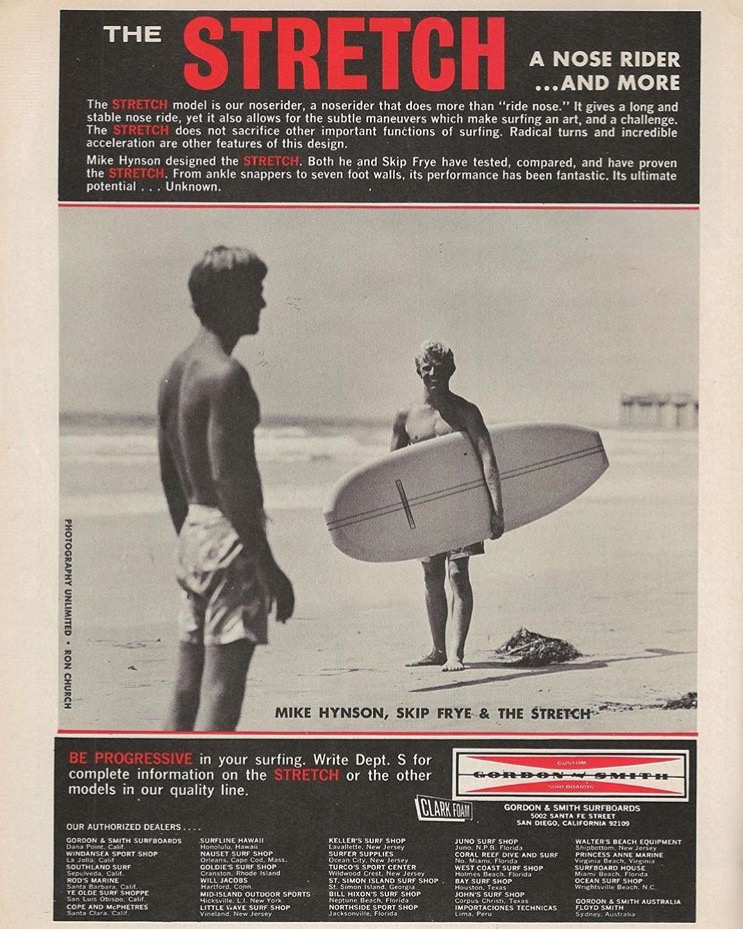
The other, more ubiquitous use is on body boards, which doesn't help the social image of squash noses one iota...
So what's the 'point' of a squash nose? What possible benefit does it have?
Look at these two squash nosed boards banking over into a turn. 1968 and 2010 respectively...

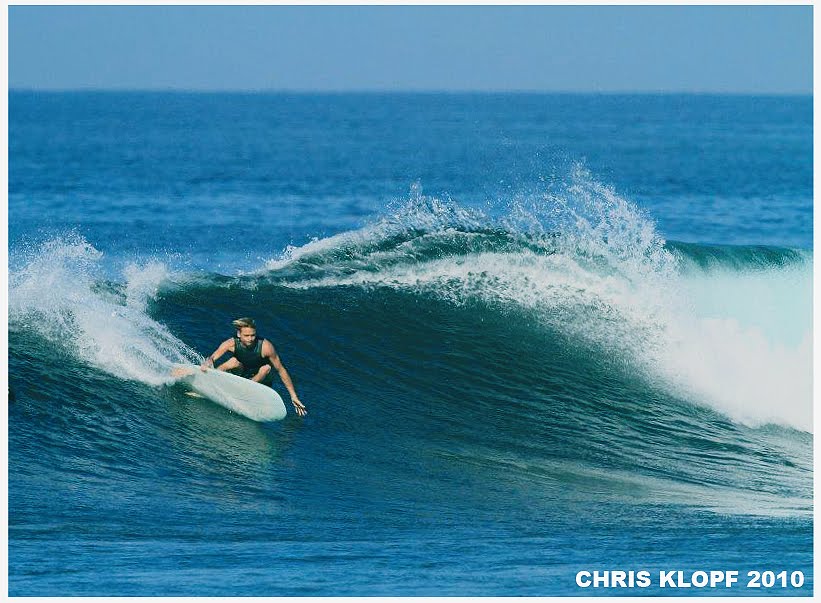
Yes, they both are wide hulls that carve easily. Yes, both surfers obviously know what they're doing. But there's an added component of 'bankitude' in both these images.
There's a reason why. It's hard to verbalize, but I'll take a stab at it.
The rate of curve is an important part of why a board (with displacement hull) wants to bank over on its rail. When you cut the nose off, you increase the rate of curve in the nose area, which encourages a board to carve up on its rail.
Let's take a 7 foot long by 22" wide hull, with the wide point 6" ahead of center. The outline in the front half of the board curves a total of 11 inches in 3 feet...which is the distance from the wide point to the end of the nose. If you cut 3 inches off the length in the nose, that 11 inches of curve would be compressed into 2' 9'', even though the curve itself didn't change until the very end of the nose. That shortened, square nosed board would ride differently.
When you push the board over on its rail in a turn, there's a subtle tendency for a board with a shorter, blunter nose to continue its banking motion beyond the energy you put into the turn. Even though the rail line that's touching the water isn't altered, the ''lateral polar moment of inertia'' in the nose area is increased. So even though the nose is completely out of the water, when you push the board over on its rail, that banking/rotating motion wants to "keep going."
Conversely, if you added length to a similar board (in the form of a longer, pointed nose) it would want to remain 'flat' on the wave face, and take more force for you to bank it over. Which is why guns are hard to bank over in small waves. And why powerful surfers in the mold of Nat Young or Michael Peterson can carve boards with a pointed nose with ease.
To prove this hypothesis -- which I have on several occasions -- take a hull with a pulled-in nose. Ride a few waves. then saw an inch off the end of the nose with a saw. Ride a few more waves. Then cut another inch off the nose, and surf it some more. Each time you do that, the board will be easier to bank over into a turn...until you go too far, and the board becomes uncontrollable.

The sweet spot would probably be somewhere between #3 and #5.
This relates more to displacement hulls than flat bottom boards. A flat bottom board will usually catch and stick if you cut the nose off. But hulls have a more complex bottom that allows for greater latitude in terms of the outline.
Look at these Boston Whalers with 'squash noses.' The hull under the bow allows them to penetrate the water with ease without the nose catching. Hull surfboards, while not as extreme, afford us the same 'best of both worlds' component.


This doesn't mean that boards with pointed noses won't bank over into a turn. Or that banking over into a turn is the end-all and be-all of hull surfing. It's just to say that...
A) Boards with blunt noses want to go up on their rail with less effort.
B) Design elements that aren't even touching the water can effect how a board rides, and how it feels.
Food for thought...


miércoles, 10 de febrero de 2021


Return of the pig

This made perfect sense to Tony - '' I have been banging on about Pigs for 50 years, since Deans I made hollow ply ones in 1963, when we were both 18 ( 1st photo above ), and then had an early Bilbo pig in the mid - 60`s ( photo 2 ). Then had another in `67 when Fitz made some at Surfboards Inc. , Woolacombe ( photo 4 Henry`s bargain ), and another in `68 when Fitz made my first S.I. V - bottom stubby ( like McTavish`s - see photo 3 ) . Then Cheyne Horan used them in the 1980`s ( see Al`s Horan board photo 5 ) .
My definition of a pig is a board with its widest point about 1/3 way up from the tail but I've never seen any official rules. In the 60s it just meant a board with its widest point towards the tail, and after that tapering towards the nose, without parallel rails thro the mid section.
Then, just after 2000, the competition racing windsurf boards suddenly became short and wide, instead of being just narrow surfboards , because they found they were - unbelievably - faster and quicker turning. Then Craig Baird at Surfworld VIC gave me an artlicle on McCoy, some of which is attached below . Seems the swine won`t go away .
As well as being a great competition tool, any average surfer should find them easier to paddle, catch waves with, and be more stable, faster and better turning than any thruster they`ve tried . Whether many UK manufacturers take this up remains doubtful ! ''


''Weber introduced this board in late 69 (Shea Weber confirmed this to me in 2006, said that either Dewey or Harold Iggy designed it), when boards dramatically dropped in size to sub 6’, think my Weber is 5’8” and the Tiki about the same. Tim Heyland had gone over to USA I believe late 69/possibly early 70’s and got the Licence to produce Weber models over here, as well as Licence for some other makes and surfing accessories. All in the attached Surf Insight article attached (this didn't load, I will get it on eventually - Al)
This huge reduction in board sizes in 1969 was most dramatic in USA, see the movie The Fantastic Plastic Machine (read the book Fantastic Plastic Voyage) when the Windansea team went on a surfing trip to South Pacific / NZ + Oz. Saw what McTavish etc were doing and were blown away by how far advanced the Oz boards were. Went back to USA told the main shapers what was going on / they saw the footage, started to chop feet of the boards, down to 5 feet in some extreme cases. The Pig design never really took off in Oz as they were building longer more function “aggressive” surfing boards. ''


Thanks to Tony Cope and Henry Marfleet for doing all the hard work on this post. Swine fever is going strong.
Suscribirse a:
Entradas (Atom)